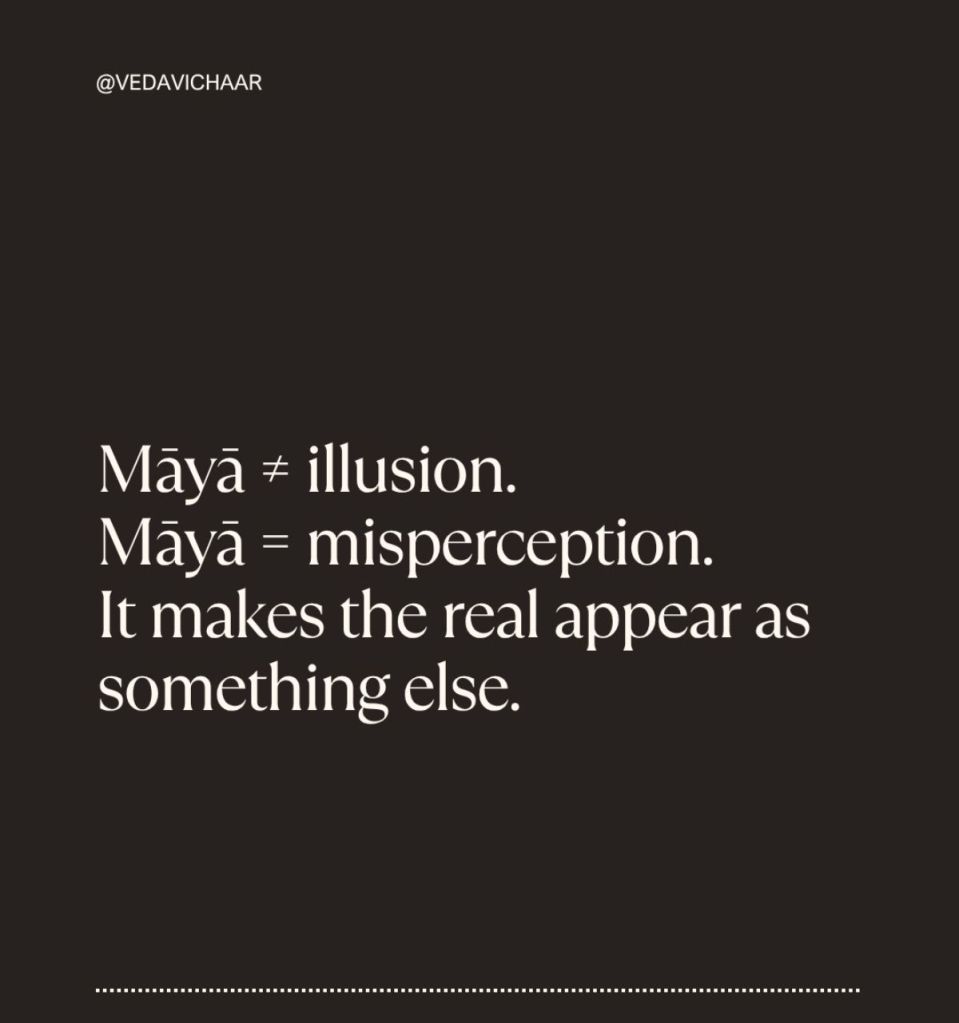
Exactly! @VedaVichar (Instagram) is spot on! Some words are simply non-translatables, as Rajiv Malhotra puts it. You can’t say ‘Manas is Consciousness, or ‘Buddhi’ is Consciousness, or all four, Manas, Chitta, Buddhi, Ahamkara is Consciousness. There is no room for reducing such detailed and complex Sanskrit words to simple one word English translation. Japanese language too is full of such kind of beautiful, high-concept words, which have no simple, one-word English translations at all.
Yes, there is no translation for these words, the same way there is no translation for the term Brahman. Brahman is something that needs to be experienced. It is not something you can explain. Like Dark Matter, Dark Energy, etc. — concepts of theoretical physics, you can only take its name, but can’t explain what exactly you mean by that. Brahman ≠ God ≠ Allah ≠ Parmatma ≠ Bhagwan. Similarly, Moksha ≠ Nirvana ≠ Salvation.
Anyway, the word in question, ‘Maya’, as it is written by VedaVichar is not illusion, but misperception (the closest English word possible) of the true reality, because of our deceiving senses and minds.
Every word, especially describing a philosophical or religious concept, has a history attached to it. One can’t escape it. If you try to do, you are deceiving yourself, as well as your audience. So, don’t. Use such words, as they are, not their popularized translations. Much of the philosophical confusion is because of these high-concept words. A Westerner who doesn’t believes in God (the Abrahamic concept of a divine entity who created this universe, is separate from it, is a caretaker and looks upon and watches it, and rewards and punishes people) will think he is an atheist and all religions are alike, i.e. BS! But an atheist need not be a nastik. Because our Brahman, or Parmatma, doesn’t invoke in our minds the same picture of reality as the word God does in a Westerner.
No wonder why Camus said: “I don’t believe in God, and I am not an atheist.” 😄
 Author Abhaidev
Leave a comment